
V-Key

V-Key

V-Key

Why Existing Mobile Software Protections are Insufficient

Er Chiang Kai - Chief Technology Officer

Why Existing Mobile Software Protections are Insufficient

In August 2018, Security researchers from Kryptowire, a security firm, found 38 different vulnerabilities loaded onto 25 Android phones, including devices from Asus, ZTE, LG and the Essential Phone, which are used by global consumers.The vulnerabilities range in severity, but some of the worst ones would allow an attacker to remotely record screens, log keystrokes, or steal private information by getting the victim to download malware.It should be shocking when a phone lands in consumers’ hands with this level of security flaw. As an industry, software security can do so much more to protect consumers, and the fact that faulty mobile security is showing up in the latest releases of phones is a great example of why this is so problematic.

The fault doesn’t rest squarely on the shoulders of the mobile manufacturers, though. Banks, governments and other trusted mobile application providers need to step up their game. This is especially so for banks, where vulnerabilities in the SWIFT network and the fact that banks are continually assaulted by sophisticated cyber crime can often mean the loss of millions of customers’ money – costing as much as US$1 million per incident.

More recently, with exploitation of text messages by cyberthieves undermining confidence around two-factor authentication, there is a clear urgency to increase efforts to work in parallel with mobile security providers to restore public confidence in delivering services over mobile applications.

What’s out there now, and why it’s not working:

Currently, there are three main types of software protection. Though they vary in effectiveness and all offer some benefits, none are as successful as we need.


1. Code obfuscation

For decades—since well before mobile—the tech industry has been trying to secure software applications from users who have access to their binary executable files, but do not want them to be able to perform reverse engineering or modify them. The traditional way of preventing code from being understood or modified is code obfuscation. All applications, no matter what language they are written in, eventually get compiled into machine instructions, which a processor reads.

A simple obfuscation approach is to change function names into random-looking names, in the hope of making it difficult for the attacker to figure out what each function does. But this only slows down the attacker a bit as the code structure is still intact. Code can be further obfuscated by taking a single instruction and separate it into many different instructions so that an attacker has to read and reverse-engineer these operations in order to figure out how to compromise them. A coder might also transform the operations by simply transforming a computation into something that is equivalent mathematically but difficult to understand, so that an attacker has to untangle what is happening to find the original intent of the code.

One problem is that doing this slows down applications. Especially in consumer-facing applications, a user expects a fast interface. They might be willing to wait for one second, but they’re not willing to wait for 10. If every instruction is obfuscated into 100 instructions, the operation will also be 100 times slower, and that’s untenable for a consumer-facing application where experience is paramount. Companies address this problem by obfuscating only the most vital pieces of code so the rest of the application is unaffected.

Often, though a company could make their code 100 times more secure, they will instead make it 10 times more secure, creating a balance between security and interface.

Even so, making something only 10 times more secure isn’t enough. If it would take an attacker one hour to break an unobfuscated code, it would only take them 10 hours—barely a day’s work—to break code that is made 10 times bigger through obfuscation. Obfuscation buys you time but doesn’t fix the underlying issues.


2. Runtime Application Self-Protection (RASP) and App Shielding

RASP or App Shielding involve putting pieces of code inside an application to detect if the application is being traced or tampered with by an attacker. Like code obfuscation, this has been a common software security strategy since pre-mobile days—most of the research and progress in the field came from web application protection, but is now common in mobile security protection. In essence, RASP watches for attacks and vulnerability exploitations, allowing the application to protect itself.

Often, RASPs are reverse engineered to identify how the threat response mechanisms are implemented. The problem here, though, is that most skilled reverse engineers would be able to bypass security protections within a short time frame by identifying where they are in the code. In the same way that code obfuscation can only hold back attackers for a limited amount of time, most RASP implementations also fail.


3. White-box cryptography

White-box cryptography is newer, relative to other protections. In this type of cryptography, a key is “dissolved” into a much larger code base. This effectively embeds the key into the code but the key itself “disappears”. Immediately, this demonstrates the first problem: white-box cryptography results in a large executable binary.

Size aside, it also doesn’t equate to perfect protection. Although it’s more secure in terms of being able to hide the key, it’s still not un-hackable. In cryptography, it doesn’t matter how well the key is secured and it doesn’t matter what the code is—if the device is compromised and the attacker can call the piece of code that performs the decryption, then white-box cryptography is effectively useless in protecting a user’s key from being used. If all you want to achieve is the confidentiality of keys, then white-box cryptography is a feasible solution. But for more complicated processes, like confidentiality of encrypted data and user attestation, it is not a secure answer.

Essentially, white-box crypto doesn’t provide any more protection than what we see with isolated hardware: it’s a very fancy way to keep keys secure, but in much the same ways that hardware is, meaning it only works until the the application that uses it is compromised, at which point it becomes useless. White-box cryptography is vulnerable to attacks and doesn’t provide the integrated security that is needed in the mobile ecosystem.


What’s the solution?

Fundamentally, all of these protections are a great place to start—but they simply don’t hold attackers back for long enough.

There is a range of security solutions that claim to solve the security problems for enterprise networks, but the simple fact is, they don’t. As an industry, we’ve taken a step back and decided that what is out there now is good enough. But, as we’ve seen, each of these security protections provides, at most, a few weeks’ delay. Every year, security practitioners go into the marketplace and try to find the top solutions that are the best and most current, but none provide true protection.

Rather than compromising, we need to develop permanent solutions to the fundamental flaws in digital software security. We need to think beyond old solutions imported from the pre-mobile world to create new, innovative software solutions specifically for mobile. We need to look past what’s buzzy or trendy to choose those new solutions that will provide lasting change. If we do all these things, we’ll finally be able to reject a status quo where “best-in-class” mobile security solutions only delay an attacker’s success instead of preventing it. Finally, we’ll have mobile apps that are actually secure.

With contribution from the Hippo Thinks research network.

Stay tuned for the next article in this series and follow us on LinkedIn and Facebook for more updates.
Other articles:
BSSN Common Criteria Compliance for Stronger Security

BSSN Common Criteria Compliance for Stronger Security

Indonesia’s digital economy is expanding rapidly, with financial services, telecoms, and government agencies increasingly reliant on secure digital platforms. To…
Securing Banking Through APRA Compliance with V-Key

Securing Banking Through APRA Compliance with V-Key

In Australia’s financial services sector, regulatory compliance is inseparable from trust and resilience. The Australian Prudential Regulation Authority (APRA) plays…
V-Key at COBA 2025: Strengthening Digital Identity and Compliance in Australia

V-Key at COBA 2025: Strengthening Digital Identity and Compliance in Australia

AUGUST, 2025 — The COBA 2025 Conference once again proved to be the premier gathering for Australia’s customer-owned banking sector.…

Shield in Minutes and Keep Your Mobile App Fast and Secure

Mobile apps have become the primary gateway for users to browse, purchase, book, track, earn rewards, and engage in real…

Modern Authentication in ANZ: Finding the Balance Between Security and User Experience

In Australia and New Zealand, authentication has reached a turning point.  Banking apps, telco platforms, superannuation portals, and digital health…

How to Choose the Right Authenticator

Authentication is essential for ensuring that only authorized individuals gain access while keeping unauthorized users out.

Navigating Business, Technology and Trust: V-Key at AIBP Malaysia 2025

The AIBP Conference & Exhibition 2025 in Kuala Lumpur brought together decision-makers from across the financial services, enterprise, and technology…
V-Key Expands to Japan, Enhancing Mobile App and Digital Identity Security

V-Key Expands to Japan, Enhancing Mobile App and Digital Identity Security

2025 June — V-Key is expanding into Japan, bringing trusted digital identity and mobile app protection to one of the…
Built for RMiT, Securing Malaysia’s Financial Future with V-Key

Built for RMiT, Securing Malaysia’s Financial Future with V-Key

More than just a requirement, compliance is what helps businesses stay strong and keep customer trust intact. This is especially…
How V-Key ID Enhances Banking Security

How V-Key ID Enhances Banking Security

In Australia’s highly regulated financial environment, robust digital identity and authentication controls aren’t just best practice, they’re a compliance imperative.…
Why Developers Shouldn’t Have to Choose Between Speed and Security

Why Developers Shouldn’t Have to Choose Between Speed and Security

Mobile development moves fast. There are always new features to launch, bugs to fix, and deadlines to meet—and developers are…
The Real Cost of Mobile App Breaches and How to Stay Ahead of Threats

The Real Cost of Mobile App Breaches and How to Stay Ahead of Threats

Mobile apps have become the primary engagement channel for modern businesses. Whether it’s a healthcare portal, an e-commerce platform, a…
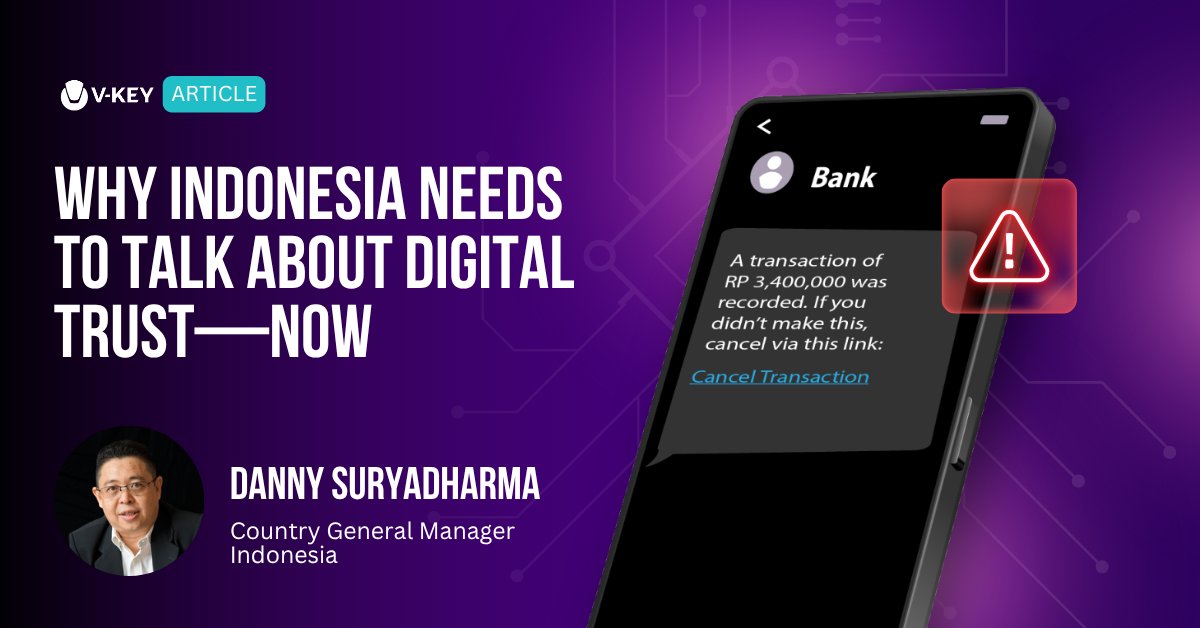
The Fake SMS That Looks Real

The Fake SMS That Looks Real

Why Indonesia needs to talk about digital trust—now.  It usually begins with a simple SMS. You’re going about your day,…

Building Digital Trust with V-Key at the State Bank of Vietnam Event 

Building Digital Trust with V-Key at the State Bank of Vietnam Event 

2025 April, Vietnam –  V-Key had the privilege of participating in the State Bank of Vietnam (SBV) CIO Roundtable event…
Journey to  Passwordless Authentication

Journey to Passwordless Authentication

Is it the Beginning of the End of Passwords?  In the wake of cyber-attacks at some of the biggest Superannuation…
Vietnam’s New Digital Security Regulations: Strengthening Mobile and Biometric Protections

Vietnam’s New Digital Security Regulations: Strengthening Mobile and Biometric Protections

Vietnam is rapidly enhancing its digital security landscape. In just the past six months, two major regulations—Decision 2345 (effective July…
Mobile Malware Landscape in 2024: Why App Security Is Critical for Businesses

Mobile Malware Landscape in 2024: Why App Security Is Critical for Businesses

Mobile malware attacks are rising as mobile banking, digital payments, and remote authentication become mainstream. In 2024, over 33.3 million…
Strengthening Australia’s Digital Identity Future 

Strengthening Australia’s Digital Identity Future 

Australia is making significant progress in digital identity adoption, with the federal government leading efforts through its national Digital ID…
Beyond OTPs: The Shift to Passwordless Authentication in Banking

Beyond OTPs: The Shift to Passwordless Authentication in Banking

The Bangko Sentral ng Pilipinas (BSP) is considering phasing out one-time passwords (OTPs) for digital banking transactions, citing the growing…
V-Key Continues to Expand in Australia to Strengthen Digital Identity and Authentication

V-Key Continues to Expand in Australia to Strengthen Digital Identity and Authentication

V-Key strengthens its presence in Australia by participating in the FIDO Alliance events in Melbourne, reinforcing its commitment to digital…
Why Passwordless Authentication is the Future of Security

Why Passwordless Authentication is the Future of Security

Managing passwords can be challenging. They can be difficult to remember, and often, people reuse them across multiple sites, which…
Protect Your Business All Year with V-Key ID and FIDO2

Protect Your Business All Year with V-Key ID and FIDO2

Lunar New Year is a time for celebration for many people around the world, but it’s also a good opportunity…
V-Key’s 2024 Journey in Advancing Digital Security and Empowering Seamless Digital Experiences

V-Key’s 2024 Journey in Advancing Digital Security and Empowering Seamless Digital Experiences

As we reflect on 2024, V-Key is proud of the milestones we’ve achieved and the innovations we’ve introduced in the…
5 Simple and Effective Ways to Secure Your Mobile App with V-OS App Shield

5 Simple and Effective Ways to Secure Your Mobile App with V-OS App Shield

For businesses, especially those handling sensitive data or financial transactions, ensuring app security is no longer optional. The risk is…
Securing Mobile Apps and Why It’s Critical for Businesses

Securing Mobile Apps and Why It’s Critical for Businesses

Mobile devices continue to become indispensable, with the average smartphone user spending around 88% of their day interacting with apps.…
Introducing V-OS App Shield: Connect, Deploy and Protect your App in Minutes

Introducing V-OS App Shield: Connect, Deploy and Protect your App in Minutes

Mobile applications are key to daily business operations, customer engagement, and overall functionality. According to Google, the average smartphone user…
V-Key partners with Bridge Alliance to build a Safer Digital Ecosystem

V-Key partners with Bridge Alliance to build a Safer Digital Ecosystem

V-Key, renowned for its advanced security solutions has proudly joined Bridge Alliance as their technology Partner,  solidifying their commitment to…
Making 2FA/MFA robust against smishing and related attacks

Making 2FA/MFA robust against smishing and related attacks

2FA/MFA was introduced to make it harder for attackers, by requiring two or more proofs of identity – also known…
How do we determine the effectiveness of mobile apps’ security systems?

How do we determine the effectiveness of mobile apps’ security systems?

With the spate of remote working regime due to Coronavirus pandemic, the reliance and growth for video conferencing platform has…
Is the detection of jailbroken/rooted phone sufficient against threats?

Is the detection of jailbroken/rooted phone sufficient against threats?

Functions that detect jailbroken/rooted devices are most commonly added to transactional mobile applications, serving as the most basic defense against…
Three steps to fight the Mobile Security status quo

Three steps to fight the Mobile Security status quo

Have financial institutions accepted a status quo that sacrifices user experience for increased security? With mobile digital identity quickly becoming…
V-OS Protection against Android Plugin malware

V-OS Protection against Android Plugin malware

There has been a recent surge in Android malware abusing Android Plugin Frameworks for malicious behavior. DroidPlugin, Parallel Space and…

V-OS Protection against CPU vulnerabilities

Virtually every computing device in the world is made unsafe by the latest disclosures on Central Processing Unit (CPU) vulnerabilities.…
The next wave of Finance: Singapore’s growing Fintech market

The next wave of Finance: Singapore’s growing Fintech market

With global cumulative investment in financial technology (fintech) forecast to exceed US$150 billion in three to five years, economies around…
Infographic: The next frontier in Banking transformation

Infographic: The next frontier in Banking transformation

As technology evolves, banks and financial institutions have no choice but to innovate. However, when it comes to security, many…
Is software-based Biometrics Authentication the solution to ASEAN’s regulatory challenges?

Is software-based Biometrics Authentication the solution to ASEAN’s regulatory challenges?

Banks in Southeast Asia should look towards software-based biometrics as the way forward to navigate the regulatory differences in the…
How does a Virtual Smart card protect a customer if they lose or change their mobile phone?

How does a Virtual Smart card protect a customer if they lose or change their mobile phone?

From banks to government agencies, many organisations are intrigued by and exploring software security solutions such as mobile tokens and…
Building V-OS with HSM

Building V-OS with HSM

V-OS is the world’s first virtual secure element, a software solution with security built into the firmware code. These include…
Cryptography in V-OS

Cryptography in V-OS

V-OS is the world’s first virtual secure element. Cryptography plays a dual-role in these; to secure and manage the secrets…
Mobile Security that works for everyone

Mobile Security that works for everyone

Safe, convenient and simple.