
V-Key

V-Key

V-Key

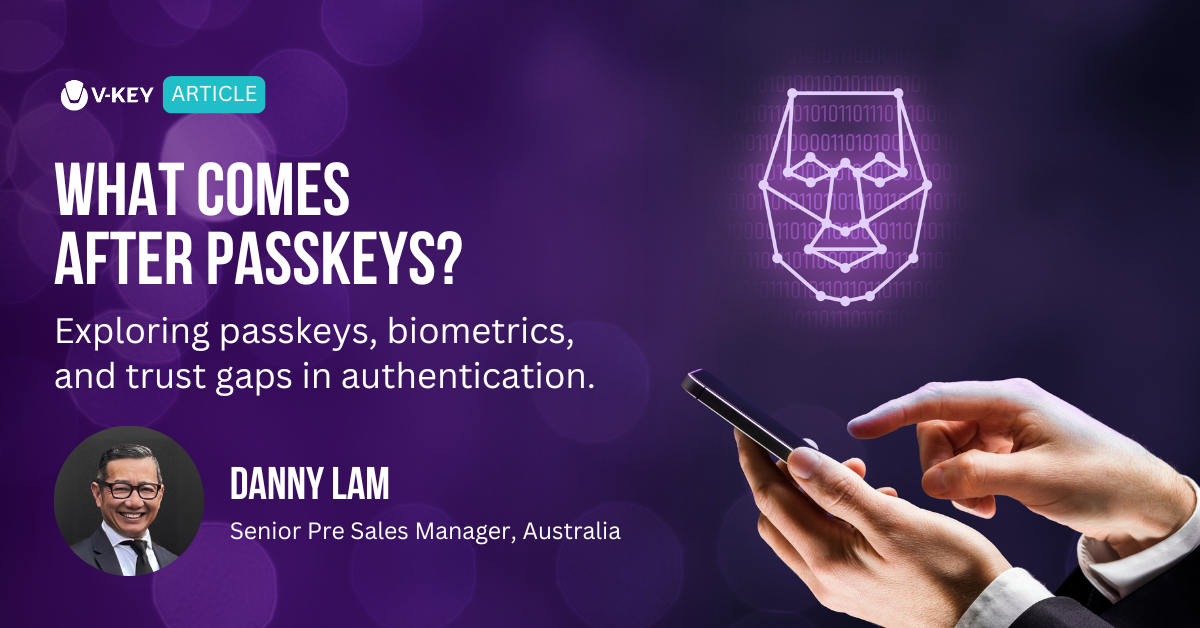
Journey to Passwordless Authentication


Is it the Beginning of the End of Passwords? 

In the wake of cyber-attacks at some of the biggest Superannuation Funds in Australia last week, one question should be asked, is this the beginning of the end of Passwords? The safety of using Passwords has been broken for a long time. Managing passwords can be dauntingly challenging. They can be difficult to remember, and often, people reuse them across multiple platforms and systems, which makes them a target for cybercriminals. In fact, according to the 2023 Verizon Data Breach Investigations Report (DBIR), over 50% of data breaches are linked to stolen or compromised credentials. This exposes sensitive data, whether it’s banking details, emails, or personal information, to potential risks.  


Last week cyber-attacks of those Australian Superannuation Funds are clearly the evidence of these issues. 


Are Passkeys safer than Passwords? 

To address these above issues, passkeys offer a more secure alternative to traditional passwords. Passkeys are meant to replace Passwords. The main reason of using Passkeys is eliminating the need to memorise password, reduce the user friction and complexity. Organisations are gradually adopting Passkeys, rather than replacing them in such Big-Bang approach. In the End, Passwords might still be around for legal reasons. 

Passkeys use cryptographic key pairs. These digital keys are unique, secure, and tied to a specific service, much like the key to your house. Passkeys operate through FIDO2, a set of standards developed by the FIDO Alliance, eliminating the need for traditional passwords. Instead of typing in a password, you authenticate using a device (with optional biometrics), providing a far more secure and convenient solution. The Private Key stays on your devices, never shared online by any platforms. They cannot be copied, reused, making them very strong resistant to phishing and thief. Hence, Passkeys are much safer than Passwords. 


Why do We need Facial Biometrics in addition to using Passkeys? 

Facial recognition offers enhanced level of security, as it is difficult to replicate or steal someone’s face, compare to stealing Passwords or PINs. 


How do Facial biometrics work?  

  • Detection: The app detects your face from your physical location, at the time you are using the app. 
  • Capture:  Device camera sensors capture your face in 3D metrics 
  • Conversion: using various algorithms, the facial captured data is mathematically converted based on your facial features. 


Do we authenticate the User? Or the Device? 

At present, the on-device biometric authentication is not directly bound to someone’s real identity profile. A much better way is getting the data drawn from your face to create a private keys that prove who you really are, and when you complete your banking, or online purchases, no biometric information is saved anywhere, compare to the current model, when sensitive data have to be encrypted and saved. 


What are the current gaps in implementation of Passkeys? 

 Most implementations store the FIDO private key in the Keystore/Keychain, which may not be deemed secure enough, especially if the keys are not stored in a Trusted Execution Environment (TEE). Even if the phone has a TEE (such as Secure Enclave), there is a general flaw in the architectural design which hackers can exploit. We call this design flaw the Trust Gap because the TEE has no way of determining the identity of the app and relies on the OS to do so. If the OS is compromised, the keys in the TEE can also be misused. This is an insidious and sophisticated attack as the targeted app does not even need to be running or be tampered with to be compromised.  

Some passkey implementations also synchronise the authentication private key to the cloud, so that the user can restore his keys when he logs in to a new phone. This means that the security of these passkeys becomes equivalent to the security of the phone manufacturer’s ID. In such cases, the level of security becomes dependent on the underlying cloud account used for backup and recovery. 

Financial institutions cannot accept that banking authentication security becomes reduced to the security of phone manufacturer’s ID. Neither will phone manufacturers accept any liability due to security breaches.    


How do V-Key overcome those Gaps/Issues? 

V-Key ID’s implementation of FIDO passkeys uses the V-OS Virtual Secure Element to protect private keys. V-OS is like a virtual TEE that provides a secure environment for cryptographic keys. Unlike the phone’s TEE, V-OS is not vulnerable to the Trust Gap issue because of how it is tightly bound to the app and its ability to scan for app tampering and runtime attacks. With V-Key ID, the V-OS protected passkeys also do not need to be synchronized to the cloud as fresh keys can be created when the user logs in with his face to a new device. This unique combination of privacy-enabled facial biometrics and a secure passkey vault (V-OS) positions V-Key ID well as the future of mobile authentication.  


V-Key ID: Taking Security to the next level 

At V-Key, we go beyond just passkeys by integrating advanced security layers like V-OS, ZeroMap, and ZeroBiometrics™ into our V-Key ID solution, enhancing mobile authentication. This approach ensures every mobile interaction is securely protected, providing a more effective and reliable passwordless experience. Whether logging into a mobile banking app or completing an online transaction, V-Key ID guarantees that only you can access your account, using something uniquely yours—your biometrics.   

A short video of Empowering the Digital Journey with our V-Key ID, a revolutionary solution that goes beyond fragmented authentication, offering a safer, more robust approach to safeguarding your digital life, can be found Here.  

By combining privacy-preserving biometrics, secure data encryption, and seamless user verification, V-Key ID establishes a new benchmark in mobile security. It offers users the convenience and confidence they need to protect their digital identity without compromising their data.  

With V-Key ID, FIDO2 standards are seamlessly implemented, providing a robust and secure authentication process that enhances security compared to traditional password-based methods. Businesses adopting this technology can offer their customers a more seamless and secure online experience, eliminating the risks associated with passwords.  


Ready to move beyond passwords? 

If you’re thinking about taking the next step toward stronger, simpler mobile authentication, we’d love to show you what’s possible with V-Key ID.   Get in touch with our team to learn more.  
BSSN Common Criteria Compliance for Stronger Security

BSSN Common Criteria Compliance for Stronger Security

Indonesia’s digital economy is expanding rapidly, with financial services, telecoms, and government agencies increasingly reliant on secure digital platforms. To…
Securing Banking Through APRA Compliance with V-Key

Securing Banking Through APRA Compliance with V-Key

In Australia’s financial services sector, regulatory compliance is inseparable from trust and resilience. The Australian Prudential Regulation Authority (APRA) plays…
V-Key at COBA 2025: Strengthening Digital Identity and Compliance in Australia

V-Key at COBA 2025: Strengthening Digital Identity and Compliance in Australia

AUGUST, 2025 — The COBA 2025 Conference once again proved to be the premier gathering for Australia’s customer-owned banking sector.…

Shield in Minutes and Keep Your Mobile App Fast and Secure

Mobile apps have become the primary gateway for users to browse, purchase, book, track, earn rewards, and engage in real…

Modern Authentication in ANZ: Finding the Balance Between Security and User Experience

In Australia and New Zealand, authentication has reached a turning point.  Banking apps, telco platforms, superannuation portals, and digital health…

How to Choose the Right Authenticator

Authentication is essential for ensuring that only authorized individuals gain access while keeping unauthorized users out.

Navigating Business, Technology and Trust: V-Key at AIBP Malaysia 2025

The AIBP Conference & Exhibition 2025 in Kuala Lumpur brought together decision-makers from across the financial services, enterprise, and technology…
V-Key Expands to Japan, Enhancing Mobile App and Digital Identity Security

V-Key Expands to Japan, Enhancing Mobile App and Digital Identity Security

2025 June — V-Key is expanding into Japan, bringing trusted digital identity and mobile app protection to one of the…
Built for RMiT, Securing Malaysia’s Financial Future with V-Key

Built for RMiT, Securing Malaysia’s Financial Future with V-Key

More than just a requirement, compliance is what helps businesses stay strong and keep customer trust intact. This is especially…
How V-Key ID Enhances Banking Security

How V-Key ID Enhances Banking Security

In Australia’s highly regulated financial environment, robust digital identity and authentication controls aren’t just best practice, they’re a compliance imperative.…
Why Developers Shouldn’t Have to Choose Between Speed and Security

Why Developers Shouldn’t Have to Choose Between Speed and Security

Mobile development moves fast. There are always new features to launch, bugs to fix, and deadlines to meet—and developers are…
The Real Cost of Mobile App Breaches and How to Stay Ahead of Threats

The Real Cost of Mobile App Breaches and How to Stay Ahead of Threats

Mobile apps have become the primary engagement channel for modern businesses. Whether it’s a healthcare portal, an e-commerce platform, a…
The Fake SMS That Looks Real

The Fake SMS That Looks Real

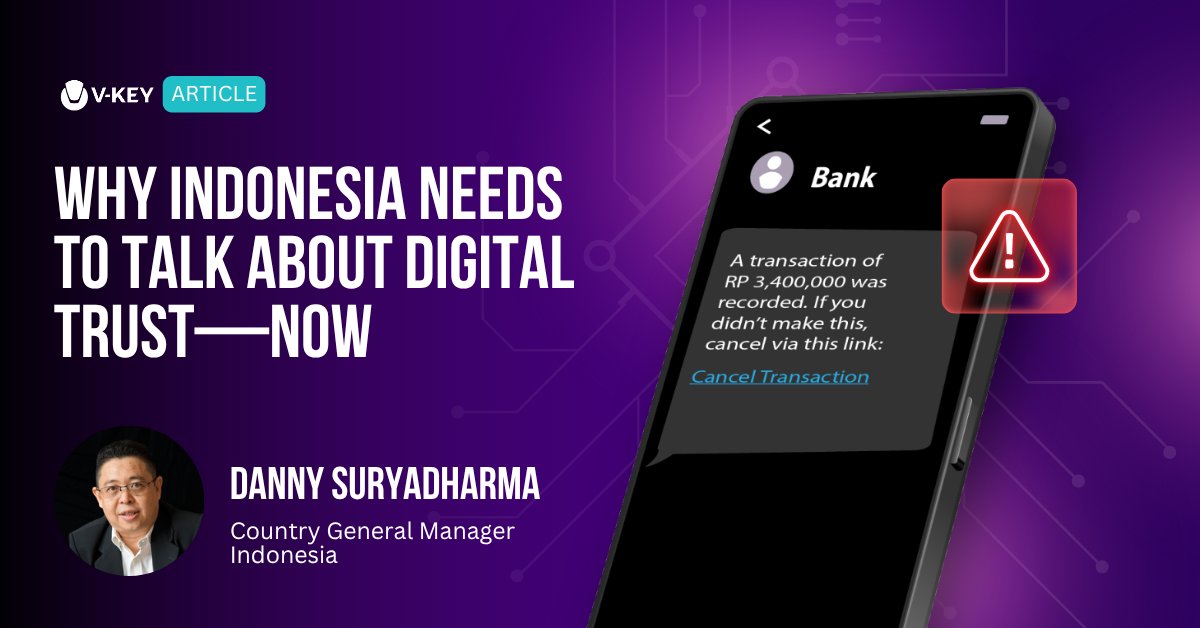
Why Indonesia needs to talk about digital trust—now.  It usually begins with a simple SMS. You’re going about your day,…
Building Digital Trust with V-Key at the State Bank of Vietnam Event 

Building Digital Trust with V-Key at the State Bank of Vietnam Event 

2025 April, Vietnam –  V-Key had the privilege of participating in the State Bank of Vietnam (SBV) CIO Roundtable event…
Vietnam’s New Digital Security Regulations: Strengthening Mobile and Biometric Protections

Vietnam’s New Digital Security Regulations: Strengthening Mobile and Biometric Protections

Vietnam is rapidly enhancing its digital security landscape. In just the past six months, two major regulations—Decision 2345 (effective July…
Mobile Malware Landscape in 2024: Why App Security Is Critical for Businesses

Mobile Malware Landscape in 2024: Why App Security Is Critical for Businesses

Mobile malware attacks are rising as mobile banking, digital payments, and remote authentication become mainstream. In 2024, over 33.3 million…
Strengthening Australia’s Digital Identity Future 

Strengthening Australia’s Digital Identity Future 

Australia is making significant progress in digital identity adoption, with the federal government leading efforts through its national Digital ID…
Beyond OTPs: The Shift to Passwordless Authentication in Banking

Beyond OTPs: The Shift to Passwordless Authentication in Banking

The Bangko Sentral ng Pilipinas (BSP) is considering phasing out one-time passwords (OTPs) for digital banking transactions, citing the growing…
V-Key Continues to Expand in Australia to Strengthen Digital Identity and Authentication

V-Key Continues to Expand in Australia to Strengthen Digital Identity and Authentication

V-Key strengthens its presence in Australia by participating in the FIDO Alliance events in Melbourne, reinforcing its commitment to digital…
Why Passwordless Authentication is the Future of Security

Why Passwordless Authentication is the Future of Security

Managing passwords can be challenging. They can be difficult to remember, and often, people reuse them across multiple sites, which…
Protect Your Business All Year with V-Key ID and FIDO2

Protect Your Business All Year with V-Key ID and FIDO2

Lunar New Year is a time for celebration for many people around the world, but it’s also a good opportunity…
V-Key’s 2024 Journey in Advancing Digital Security and Empowering Seamless Digital Experiences

V-Key’s 2024 Journey in Advancing Digital Security and Empowering Seamless Digital Experiences

As we reflect on 2024, V-Key is proud of the milestones we’ve achieved and the innovations we’ve introduced in the…
5 Simple and Effective Ways to Secure Your Mobile App with V-OS App Shield

5 Simple and Effective Ways to Secure Your Mobile App with V-OS App Shield

For businesses, especially those handling sensitive data or financial transactions, ensuring app security is no longer optional. The risk is…
Securing Mobile Apps and Why It’s Critical for Businesses

Securing Mobile Apps and Why It’s Critical for Businesses

Mobile devices continue to become indispensable, with the average smartphone user spending around 88% of their day interacting with apps.…
Introducing V-OS App Shield: Connect, Deploy and Protect your App in Minutes

Introducing V-OS App Shield: Connect, Deploy and Protect your App in Minutes

Mobile applications are key to daily business operations, customer engagement, and overall functionality. According to Google, the average smartphone user…
V-Key partners with Bridge Alliance to build a Safer Digital Ecosystem

V-Key partners with Bridge Alliance to build a Safer Digital Ecosystem

V-Key, renowned for its advanced security solutions has proudly joined Bridge Alliance as their technology Partner,  solidifying their commitment to…
Making 2FA/MFA robust against smishing and related attacks

Making 2FA/MFA robust against smishing and related attacks

2FA/MFA was introduced to make it harder for attackers, by requiring two or more proofs of identity – also known…
How do we determine the effectiveness of mobile apps’ security systems?

How do we determine the effectiveness of mobile apps’ security systems?

With the spate of remote working regime due to Coronavirus pandemic, the reliance and growth for video conferencing platform has…
Is the detection of jailbroken/rooted phone sufficient against threats?

Is the detection of jailbroken/rooted phone sufficient against threats?

Functions that detect jailbroken/rooted devices are most commonly added to transactional mobile applications, serving as the most basic defense against…
Three steps to fight the Mobile Security status quo

Three steps to fight the Mobile Security status quo

Have financial institutions accepted a status quo that sacrifices user experience for increased security? With mobile digital identity quickly becoming…
V-OS Protection against Android Plugin malware

V-OS Protection against Android Plugin malware

There has been a recent surge in Android malware abusing Android Plugin Frameworks for malicious behavior. DroidPlugin, Parallel Space and…

V-OS Protection against CPU vulnerabilities

Virtually every computing device in the world is made unsafe by the latest disclosures on Central Processing Unit (CPU) vulnerabilities.…
The next wave of Finance: Singapore’s growing Fintech market

The next wave of Finance: Singapore’s growing Fintech market

With global cumulative investment in financial technology (fintech) forecast to exceed US$150 billion in three to five years, economies around…
Infographic: The next frontier in Banking transformation

Infographic: The next frontier in Banking transformation

As technology evolves, banks and financial institutions have no choice but to innovate. However, when it comes to security, many…
Is software-based Biometrics Authentication the solution to ASEAN’s regulatory challenges?

Is software-based Biometrics Authentication the solution to ASEAN’s regulatory challenges?

Banks in Southeast Asia should look towards software-based biometrics as the way forward to navigate the regulatory differences in the…
How does a Virtual Smart card protect a customer if they lose or change their mobile phone?

How does a Virtual Smart card protect a customer if they lose or change their mobile phone?

From banks to government agencies, many organisations are intrigued by and exploring software security solutions such as mobile tokens and…
Building V-OS with HSM

Building V-OS with HSM

V-OS is the world’s first virtual secure element, a software solution with security built into the firmware code. These include…
Cryptography in V-OS

Cryptography in V-OS

V-OS is the world’s first virtual secure element. Cryptography plays a dual-role in these; to secure and manage the secrets…

Why Existing Mobile Software Protections are Insufficient

Recognizing that existing mobile software protections are insufficient against today’s cyber threat landscape, we take a closer look at the main…
Mobile Security that works for everyone

Mobile Security that works for everyone

Safe, convenient and simple.